Tampilkan postingan dengan label bank negara malaysia. Tampilkan semua postingan

Selasa, 02 Juli 2019

[Insurance] What you need to know about the New Regulations on Investment-Linked Plans? (July 2019)


If you are planning to purchase an Investment-Linked Plan (ILP) insurance policy, then you should take note of the new regulations by Bank Negara that came into effect on 1 July 2019.


In January 2019, Bank Negara released a policy document that set several new requirements that investment-linked insurance providers must adhere to from 1 July 2019 onwards. Why? These requirements were designed with the primary objective of protecting the interests of policy holders.

Continue to read here...


The salient requirements are as follows:

  • Implementation of standards on *Minimum Allocation Rates (MAR) to protect the account values of IL policy/certificate owners;

  • Minimum standards on sustainability tests and communication to policy/certificate owners to improve long term persistency of IL policies/certificates and consumer awareness; and


  • Strengthened disclosure standards on product illustration to facilitate more informed decision-making by consumers.


Allocation changes for one of the ILP plans from an insurer.


What does “Minimum Allocation Rate (MAR)”  means?
It refers to the minimum proportion of premiums payable by policy owner/takaful contributions made by takaful participant that is allocated in the unit fund(s) of choice before the deduction of any charges.


What should investment-linked policy owners/takaful participants do?

For existing owners of investment-linked policies/certificates and consumers who have purchased an investment policy/certificate before 1 July 2019, you should:

  • Understand the term of your contract and how long your coverage is expected to last, based on the current level of premium/contribution.
  • Contact your insurer/takaful operator or agents (insurance/takaful/bancassurance) for further clarification, if necessary.
  • Receive a letter from your insurer/takaful operator providing information on sustainability of coverage from 1 July 2019. Please discuss with your insurer, takaful operator or agent (insurance/takaful/bancassurance) on how the information on sustainability of coverage affects the terms and conditions of your contract, and meets your insurance/takaful protection needs.
  • Continuously review your protection needs and financial situation, and be aware of any changes to the tenure your coverage is expected to last.
  • Understand the options available to manage the investment-linked policies/certificate to meet your needs and discuss them with your insurers, takaful operators or agents (insurance/takaful/bancassurance) where necessary.
  • Take appropriate action, if necessary.


Image result for investment linked insurance gif file

Beginning 1 July 2019, for consumers who intend to buy a new investment-linked policy/certificate, you should:

  • Understand that the premiums/contributions quoted at point of sale are expected to be sufficient to fund coverage until the end of the contractual term.
  • Review carefully the terms and conditions to ensure that they meet your insurance/takaful protection needs.
  • Continuously review your protection needs and financial situation and be aware of any changes to the tenure your coverage is expected to last.
  • Understand the options available to manage the investment-linked policies/certificate to meet your needs and discuss them with your insurers, takaful operators or agents (insurance/takaful/bancassurance) where necessary.
  • Take appropriate action, if necessary.


Follow our active updates via Facebook @FinanceMalaysia

Kamis, 28 Maret 2019

5 Key Highlights of Bank Negara Malaysia Annual Report 2018


Too lazy to read the full annual report?

No worry... Let us summarise
 for you with these 5 key highlights :)


What's the forecast for 2019 and why?


How about the Inflation Rate and what factors affecting it in 2019?


Would our Current Account balance still able to record Surplus?


Are Malaysians workers paid fairly?
(Assessment based on productivity and equity)


Our External Debt is within control?


Follow our active updates via Facebook @FinanceMalaysia


Kamis, 14 Februari 2019

[Latest] How Was Malaysia Doing in 4Q 2018 ???

Today, yes during Valentine's Day, Bank Negara Malaysia (BNM) released its 4Q 2018 report to the general public. Fortunately, the result is above forecasts with the economy expanded at 4.7% in the fourth quarter of 2018 (Q4 2018), after two consecutive quarters of moderation earlier.


Read the Key Highlights here:


  • Higher economic growth of 4.7%, higher than consensus forecasts of 4.5%
  • Continued expansion across most sectors, with the exception of commodity-related sectors
  • Services and manufacturing sectors remained the key drivers of growth
  • Malaysia's macroeconomic fundamentals continue to remain strong despite domestic and external headwinds.

For 2018, the value of the gross domestic product (GDP) recorded RM1.23 trillion at constant prices and RM1.43 trillion at current prices.


  • Headline inflation declined in the fourth quarter of 2018 as transport inflation turned negative reflecting the fixed domestic RON95 petrol and diesel prices
  • The combined outcome of the changes in consumption tax policy continued to exert an overall downward impact to headline inflation


  • Malaysia’s external debt stood lower at RM924.9 billion, or 64.7% of GDP as at end December 2018 (end-September 2018: RM933.3 billion or 65.3% of GDP).
  • The country’s external debt remains manageable, given its currency and maturity profiles, and the presence of large external assets.
  • Close to one-third of external debt is denominated in ringgit (31.1%; end-September: 31.3%)


How about this year 2019?
According to BNM, the Malaysian economy is likely to remain on a steady 
growth path given below factors:

  • Global growth reverting to the long-term trajectory
  • Resilience of private consumption and continuation of civil engineering projects
  • Recovery from supply side shocks
  • Commencement of new production facilities (RAPID, E&E, retail outlet expansion)
  • Materialisation of approved manufacturing investment
Source: Bank Negara Malaysia

Follow our active updates via Facebook @financemalaysia

Jumat, 07 Desember 2018

A New Way of Transferring Money via DuitNow !!!


Remember this date, 8 December 2018, it will mark another milestone in the financial industry in Malaysia with the launching of DuitNow money transfer service. The new service was introduced to eliminate the below conversations between all banking users:

"Please give me your bank account details..."
"What's your bank account number again?"
"Which bank is your account? I forgot..."


Now, you don't have to ask your friends their lengthy bank account number anymore. With DuitNow, you can send money instantly on a 24/7 basis to mobile numbers, NRIC numbers or business registration numbers.

Send and receive funds instantly anytime, anywhere.

Instantly?Yes, because the name was 'Do-it-Now' actually.

How can I receive money using DuitNow?

You must first register for DuitNow by linking one of the following IDs with your bank account or e-money (e-wallet) account at participating banks and payment providers:

  1. Your Mobile number
  2. Your NRIC number
  3. Your Passport number
  4. Business registration number (only SSM-registered businesses)

Once you have registered, payers can direct payments to you using the registered ID
(DuitNow ID).


Do I need to register with DuitNow?
Registration is not required to send money via DuitNow. However, in order to receive money via DuitNow, a one-time registration is needed to link your ID with your bank account or e-money account (e-wallet).


Important Question: Do I have to Pay for the service?

  • No, it is absolutely FREE for consumers to send and receive money up to RM5,000.
  • For transaction above RM5,000, a 50 sen fee may be applicable. However, some banks are waiving this fee.
  • For businesses, please check with your bank for transaction fee information.


What's the Transaction Limit?

  • Consumers may transfer up to RM 50,000 per transaction at banks.
  • Businesses may transfer up to RM 10,000,000 per transaction at banks.
  • The limit may vary depending on your bank's channels.
  • But, e-Money (e-wallet) payment providers will definitely have lower limits.


For more information, please visit https://www.duitnow.my/
Don't forget to follow our active updates via Facebook @financemalaysia

Sabtu, 17 November 2018

Why e-Wallet will be the Future Payment Method in Malaysia?

Throw away your wallet! Replacing it with e-Wallet! You like it or not, the future of making transactions will be via electronic-wallet or QR code payments. We called it as e-Wallet.

In recent years, QR code payments are increasingly being seen as an affordable alternative 
to cash payments, particularly in Asia where mobile phone penetration is relatively higher. Across different jurisdictions, regulatory approaches have varied.


Considering Malaysia’s market characteristics, Bank Negara Malaysia has adopted a unique approach that aims to ensure a unified and interconnected network amid the proliferation of QR code payment providers. Hopefully, this will be happening very soon.

What's the central bank's initiatives on e-wallet ?


As at end-October 2018, there are a total of 37 non-banks e-wallet companies in Malaysia:

  1. AEON Credit Services (M) Berhad
  2. Alipay Malaysia Sdn Bhd (formerly known as helloPay Malaysia Sdn Bhd)
  3. Axiata Digital eCode Sdn. Bhd.
  4. Bandar Utama City Centre Sdn. Bhd.
  5. BigPay Malaysia Sdn. Bhd.
  6. Celcom eCommerce Sdn. Bhd. (formerly known as Celcom Multimedia (Malaysia) Sdn. Bhd.)
  7. Chevron Malaysia Limited
  8. DIV Services Sdn Bhd (formerly known as ePetrol Services Sdn Bhd)
  9. Fass Payment Solutions Sdn. Bhd.
  10. Finexus Cards Sdn. Bhd. (formerly known as MAA Cards Sdn. Bhd.)
  11. Fullrich Malaysia Sdn Bhd
  12. GPay Network (M) Sdn Bhd
  13. iPay88 (M) Sdn. Bhd.
  14. I-Serve Payment Gateway Sdn Bhd
  15. JuruQuest Consulting Sdn. Bhd.
  16. ManagePay Services Sdn. Bhd.
  17. Maxis Broadband Sdn. Bhd.
  18. Merchantrade Asia Sdn Bhd
  19. Mobile Money International Sdn. Bhd.
  20. MobilityOne Sdn Bhd
  21. MOL AccessPortal Sdn. Bhd.
  22. MRuncit Commerce Sdn. Bhd.
  23. Numoni DFS Sdn. Bhd. (formerly known as Com2U Sdn. Bhd.)
  24. PayPal Pte. Ltd.
  25. Petron Fuel International Sdn. Bhd.
  26. Presto Pay Sdn. Bhd. (formerly known as EPP Solution Sdn. Bhd.)
  27. Raffcomm Sdn. Bhd. 
  28. Shell Malaysia Trading Sdn. Bhd.
  29. SiliconNet Technologies Sdn. Bhd.
  30. Silverlake Global Payments Sdn. Bhd. 
  31. SMJ Teratai Sdn Bhd
  32. Touch 'n Go Sdn. Bhd.
  33. TNG Digital Sdn. Bhd.
  34. Valyou Sdn. Bhd.
  35. Webonline Dot Com Sdn. Bhd.
  36. WeChat Pay Malaysia Sdn. Bhd.
  37. XOX Com Sdn. Bhd.

Meanwhile, there are a few Banks with e-money issuer license as well.

  1. AmBank (M) Berhad
  2. Bank of China (M) Berhad
  3. CIMB Bank Berhad
  4. Malayan Banking Berhad
  5. RHB Bank Berhad


Wow... So many of them!
Which one should we use?
Cannot be all. Right?


No worry.
We will blog about a few of most widely used or most popular e-wallet in Malaysia.

Stay tuned !!!


Follow our active updates via Facebook @financemalaysia

Minggu, 13 Mei 2018

Knowing the 5 'Avengers' of “Council of Elders” by Tun Mahathir


First of all, let us congratulates Pakatan Harapan (PH), lead by Tun Mahathir, coming with a beautiful victory over the ruling coalition Barisan Nasional (BN) on 9th May 2018. This is the 14th general election of Malaysia where Malaysians vote to decide who to lead the country forward. The mandate was given for 5 years, and Tun Mahathir scores the many history records on this beloved country and the world.

And, one of the first by the newly elected Prime Minister (PM) Tun Mahathir was by setting up a "council of elders" comprising 5 experts from various fields whom will serve as advisors to the new government in order to rectify the current 'troubled' economic problems of the country. Let us know the background of these 'Avengers' to save the country...


Tun Daim Zainuddin
  • Former finance minister (1984 - 1991) under the same boss Tun Mahathir as PM then.
  • Also, he is a businessman and politician, especially during the new economic policy (NEP) era.
  • Came back to the office as finance minister after the 97/98 Asian financial crisis to help out Tun Mahathir once again. (1999 - 2001)
  • Instrumental in implementing the "Look Far Eastern Policy" in 1980s, successfully transforming the local working culture (punch card system) and attracting Japanese corporations to set up factories/businesses here, modernizing the local manufacturing sector.
Tan Sri Zeti Akhtar Aziz
  • The longest-serving former Bank Negara Governor. (2000 - 2016)
  • Named as world's best central bank chiefs in 2009 by Global Finance magazine.
  • Accorded “Grade A” among the heads of central banks for the 10th time by the Global Finance magazine in 2013.
  • Chairman of the Asian Institute of Finance.


Tan Sri Hassan Merican
  • Former Petronas CEO who oversees the national oil giant which is one of the main income sources for the country. (1995 - 2010)
  • Chairman of SembCorp Industries Ltd (since 2010) & SembCorp Marine Ltd (since 2014).
  • Director of ConocoPhillips (2013 - 2015)
  • Chairman of Singapore Power, Pavilion Energy, Pavilion Gas and Lan Ting Holdings and holds directorships in Sarawak Energy, Lambert Energy Advisory and MH Marican Advisory.
  • He is also a senior international advisor at Temasek International Advisors.


Robert Kuok
  • A tycoon who was the richest person in the country, having a business empire which spanning from sugarcane plantations (Perlis Plantations Bhd), sugar refineries, flour milling, animal feed, oil, mining, finance, hotels, properties, trading, freight, and publishing.
  • The biggest source of wealth is his stake in Wilmar International, the world's largest listed palm oil company.
  • According to Forbes, his net worth is estimated at $15.2 billion on May 2018.
  • His book 'Robert Kuok, A Memoir' published late 2017 stir a debate after it contains Kuok’s frank views on Chinese in South-East Asia, his dealings with Malaysia’s former premiers, his take on Malaysia’s economic policies.


Prof Jomo Kwame Sundaram
  • A prominent Malaysian economist.
  • Served as the United Nations Assistant Secretary-General for Economic Development. (2005 - 2012)
  • Visiting Senior Fellow at Khazanah Research Institute.
  • Visiting Fellow at the Initiative for Policy Dialogue, Columbia University.
  • Adjunct Professor at the International Islamic University, Malaysia.
  • Before the Asian financial crisis in 1997–98, Jomo was an early advocate of appropriate new capital account management measures, which then PM Mahathir later introduced.

Speaking to Bernama after their first meeting, Tun Daim said the five-member team was briefed and deliberated on the current economic situation, the national debt, the ringgit, GST and fuel subsidies, among others.


Tun Daim said the council would be calling the Public Private Partnership Unit, which is under the Prime Minister's Department, related ministries and government-linked companies (GLCs) to brief them on various mega projects and the governance of GLCs, including Lembaga Tabung Haji (LTH), Majlis Amanah Rakyat (Mara), and the Federal Land Development Authority (FELDA).

Meanwhile, Tun Daim said the team would hold meetings daily for 100 days, and in fact, on some days, it would be a few times a day. Thereafter, their job was done.

Rabu, 28 Maret 2018

3 Key Takeaways from Bank Negara Malaysia Annual Report 2017

Against a background of broad-based global recovery and the relatively low volatility in the international financial markets, the Malaysian economy performed strongly in 2017. The Annual Report provides an analysis of the developments in the Malaysian economy and outlines the future challenges.


Key highlights:

In 2017, the Malaysian economy recorded a robust growth of 5.9% (2016: 4.2%), supported by faster expansion in both private and public sector spending. A key highlight of the year was the rebound in gross exports growth as global demand strengthened. This was due mainly to higher demand from major trading partners following the upswing in the global technology cycle, investment expansion in the advanced economies and the turnaround in commodity prices.

Economy to grow between 5.5% - 6.0% in 2018


Headline inflation increased to 3.7% in 2017 (2016: 2.1%). Inflation remained volatile during the year and was primarily driven by higher domestic fuel prices. Higher global commodity prices and disruptions in domestic food supplies also contributed to the higher inflation.

This, however, was mitigated by the stronger ringgit exchange rate since April 2017, which helped contain the rise in production costs for domestic goods. Core inflation was also higher in 2017, averaging at 2.3% for the year (2016: 2.1%). Nevertheless, demand-driven inflationary pressures remained largely stable given the lack of persistent tightness in capital stock and the absence of significant wage pressures.
Headline inflation expected to be between 2.0% - 3.0% in 2018

Malaysia’s external position improved considerably in 2017, benefiting from the favorable global economic landscape and relatively lower volatility in the international financial markets. Malaysia recorded a higher current account surplus, largely due to a higher goods surplus following the strong export performance, which more than offset widening deficits in the services and primary income accounts.

Gross exports rebounded to grow strongly by 18.9% (2016: 1.2%), driven mainly by export volumes, particularly in manufactured exports. Gross imports also registered double-digit growth of 19.9% (2016: 1.9%), mainly reflecting higher imports of intermediate goods, capital goods, and goods for re-exports. The increase in imports was in line with the robust manufacturing exports, more rapid investment in the manufacturing and services sectors, and robust global demand. 

Gross export will continue to record above-average growth in 2018

Source: Bank Negara Malaysia Annual Report 2017

Kamis, 01 Maret 2018

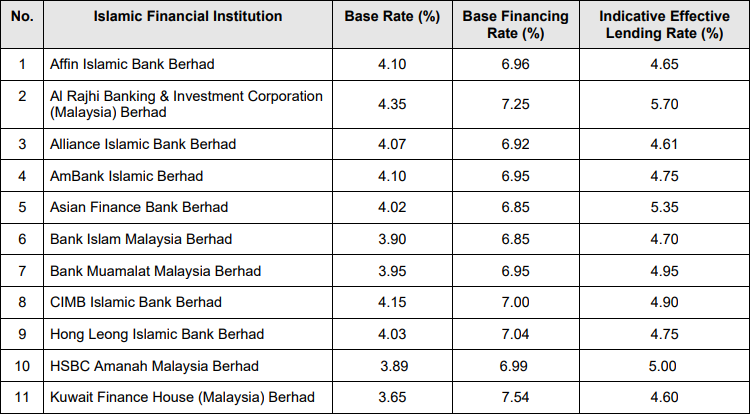
[Banks] BR, BLR/BFR and Indicative Effective Lending Rates as at 19th Feb 2018

After the latest Overnight Policy Rate (OPR) hike by Bank Negara Malaysia (BNM) in January 2018, all the banks and financial institutions react to increase their lending rates accordingly.


Note:
* Indicative effective lending rate refers to the indicative annual effective lending rate for a standard 30-year housing loan/home financing product with financing amount of RM350k and has no lock-in period.


As at 19 February 2018
Bank Negara Malaysia 

Selasa, 27 Februari 2018

Bank Negara Malaysia issues policy document for digital currencies

Bank Negara Malaysia (“the Bank”) has today issued the Anti-Money Laundering and Counter Financing of Terrorism Policy for Digital Currencies (Sector 6) which has taken into account feedback received during the public consultation period on the exposure draft released on 14 December 2017. The policy aims to ensure that effective measures are in place against money laundering and terrorist financing risks associated with the use of digital currencies and to increase the transparency of digital currency activities in Malaysia.


What does the policy states ???
The public is reminded that digital currencies are not legal tender in Malaysia. Accordingly, digital currency businesses are not covered by prudential and market conduct standards or arrangements that are applicable to financial institutions regulated by the Bank. Members of the public are advised to carefully evaluate the risks associated with dealings in digital currencies. 

Any persons carrying on activities involving digital currencies should refer to the details within the policy to determine its applicability and comply accordingly. Persons covered under the policy as reporting institutions are expected to comply with the provisions of the Companies Act 2016 including the requirement to be incorporated or registered.

Members of the public may access the policy document as well as a list of common questions and feedback on the Bank's website at http://www.bnm.gov.my/.

Commonly asked questions and feedback from BNM:
Will BNM regulate Initial Coin Offerings (ICO)?Activities related to ICOs are under the purview of the Securities Commission.
• If the ICO involves activities that fall within the scope of services defined under section 4.1 of the policy document, then that activity is under the ambit of the guideline. 

Can BNM consider allowing Digital Currency Exchangers (DCEs) to use selfies in verifying customer’s identity? How does a DCE view the original document?
• The Bank places no restriction on using electronic means of performing the necessary customer due diligence (CDD) or verification of a customer’s identity. However, such methods must satisfy the requirement under Section 9.3.3 which stipulates the process has to be as effective as that of a face-to-face process.
• Reporting institutions (“RI”) can view identification documents physically or via electronic
means, as long as the RI can reasonably determine its authenticity. 

Will Peer-to-Peer (P2P) transactions be covered under the proposed policy document?• As long as the P2P transactions that are offered as services satisfy the definition under section 4.1, they will be required to adhere to requirements as reporting institutions. 

What is BNM’s view on the imposition of tax on currency trading profit?• This issue is under the purview of the Inland Revenue Board (IRB). But as a matter of principle, businesses should be obligated to pay tax on revenues they generate domestically. 

Can individuals run a digital currency exchange business without registering company with the Companies Commission of Malaysia?
• The Bank expects any person any persons, whether local or foreign, to be incorporated or registered under the Companies Act 2016 if they are carrying on or intending to carry on the activities listed in Paragraph 4.1 of the policy in Malaysia. 

(Source: Bank Negara Malaysia website)